Create a PRD from support tickets

Create a PRD from support tickets

Create a PRD from support tickets

Apps & files

Apps & files

Connectors

Connectors

Image & video generation

Image & video generation

UX/Design

UX/Design

IT

IT

Tech

Tech

Overview

Overview

Overview

Computer can turn raw interviews and support tickets from a workforce scheduling product into a complete strategy package — research synthesis, personas, a PRD, a RICE‑scored roadmap, and an exec‑ready deck. It structures qualitative and quantitative signals into clear opportunities, picks a single lead bet, and outputs presentation‑ready artifacts a PM can walk straight into leadership with.

Computer can turn raw interviews and support tickets from a workforce scheduling product into a complete strategy package — research synthesis, personas, a PRD, a RICE‑scored roadmap, and an exec‑ready deck. It structures qualitative and quantitative signals into clear opportunities, picks a single lead bet, and outputs presentation‑ready artifacts a PM can walk straight into leadership with.

Computer can turn raw interviews and support tickets from a workforce scheduling product into a complete strategy package — research synthesis, personas, a PRD, a RICE‑scored roadmap, and an exec‑ready deck. It structures qualitative and quantitative signals into clear opportunities, picks a single lead bet, and outputs presentation‑ready artifacts a PM can walk straight into leadership with.

Query:

Query:

Query:

I'm a product manager at a workforce scheduling SaaS company. I just finished a round of user research (5 interviews) and I have our support ticket theme data from last quarter. Please do the following: Synthesize the research: Identify key themes across all 5 interviews and the support data. Build 2-3 user personas. Score the top opportunities by impact and evidence strength. Write a PRD for the #1 opportunity you identify. Include problem statement grounded in the research data, user stories, P0/P1/P2 requirements, success metrics, and acceptance criteria. Build a prioritized roadmap (Now/Next/Later format) for the top 5 opportunities using RICE scoring. Include the rationale for sequencing. Produce a stakeholder presentation (PowerPoint, 10-12 slides) that I can present to my exec team covering: research findings, personas, the recommended roadmap, the lead feature PRD summary, and success metrics. Make it data-driven — reference the actual numbers from the interviews and support data.

I'm a product manager at a workforce scheduling SaaS company. I just finished a round of user research (5 interviews) and I have our support ticket theme data from last quarter. Please do the following: Synthesize the research: Identify key themes across all 5 interviews and the support data. Build 2-3 user personas. Score the top opportunities by impact and evidence strength. Write a PRD for the #1 opportunity you identify. Include problem statement grounded in the research data, user stories, P0/P1/P2 requirements, success metrics, and acceptance criteria. Build a prioritized roadmap (Now/Next/Later format) for the top 5 opportunities using RICE scoring. Include the rationale for sequencing. Produce a stakeholder presentation (PowerPoint, 10-12 slides) that I can present to my exec team covering: research findings, personas, the recommended roadmap, the lead feature PRD summary, and success metrics. Make it data-driven — reference the actual numbers from the interviews and support data.

Key Output

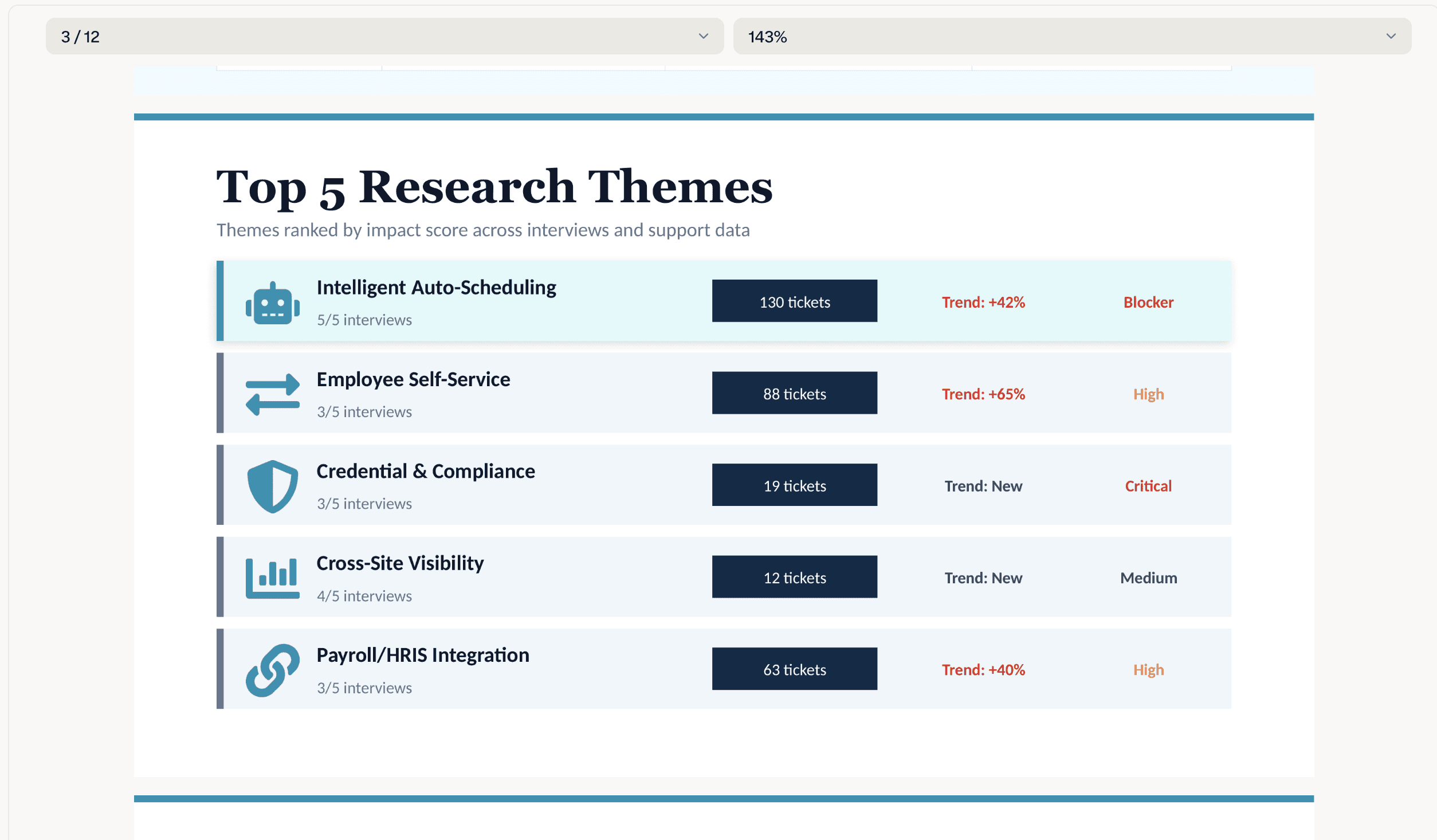
Computer ingested five user interviews plus 312 scheduling‑related support tickets and clustered them into five themes, with intelligent auto‑scheduling emerging as the top opportunity backed by 5 of 5 interviews and 130 tickets, trending up sharply.

It then defined three personas — the Operations Orchestrator, Compliance Guardian, and People‑First HR Leader — each grounded in real quotes, quantified pains (like $340K/quarter overtime overruns and $1M+/year coordinator labor), and explicit switch triggers. Using this synthesis, Computer scored opportunities by impact and evidence and selected intelligent auto‑scheduling as the #1 bet.

From there, it drafted a full PRD for the auto‑scheduling engine, including a research‑backed problem statement, detailed user stories for ops leaders and managers, six P0 requirements (constraint rule engine, one‑click schedule generation, smart replacements, compliance validation, manager overrides with impact visibility, and ADP/Workday integration), P1/P2 follow‑ons, success metrics (like 80% reduction in schedule creation time and 50% cut in overtime overruns), and open questions for engineering, legal, design, and data.

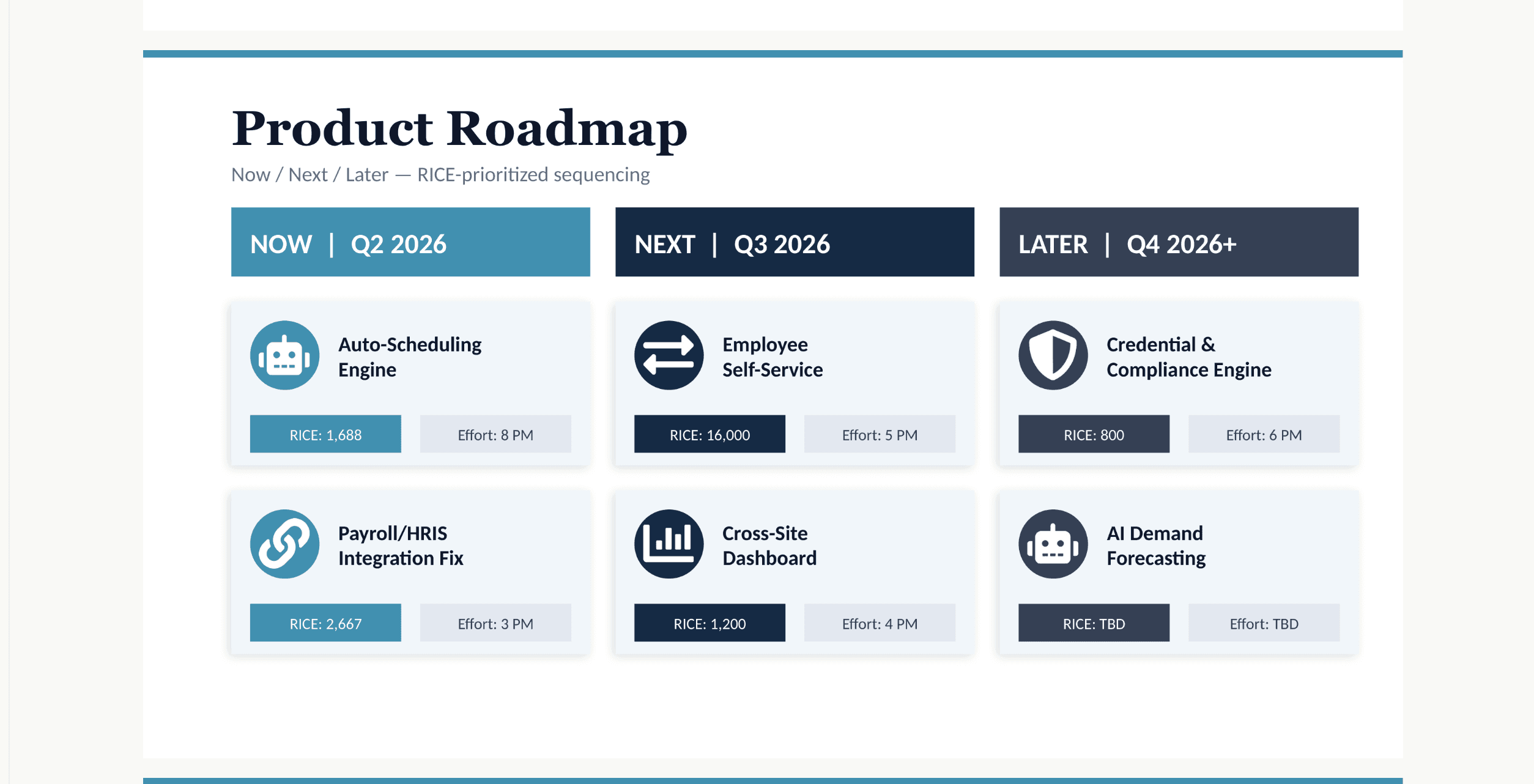
It also built a RICE‑scored roadmap that places auto‑scheduling and integration hardening in “Now,” employee self‑service and cross‑site dashboards in “Next,” and a credential/compliance engine in “Later,” with clear sequencing rationale. Finally, Computer produced a 12‑slide stakeholder deck with charts on ticket trends, persona cards, an opportunity scoring table, the RICE roadmap, a PRD summary, and quantified cost‑of‑inaction numbers, giving the PM a ready‑to‑present narrative for the exec team.

Tips

  • Tighten segment focus – Add one line on your target customer, for example: “Optimize decisions for 500–5,000‑employee multi‑site customers in healthcare, logistics, and retail first.”

  • Constrain roadmap horizons – Specify timeframes, for example: “Define Now as the next 2 quarters, Next as the following 2, and Later as 12+ months out.”

  • Shape the exec narrative – Tell Computer how you want to sell the story, for example: “Emphasize quantified cost of inaction and attach each roadmap item to a specific revenue or churn impact.”