

What is a Project?
A Project is a persistent, shareable workspace in Perplexity that keeps everything for an ongoing effort in one hub — your Search conversations, your Computer tasks, files, custom instructions, connected tools, and the context Perplexity builds up as you work. Instead of one-off tasks, a Project lets you and any collaborators return to the same body of work over time.
Creating a Project
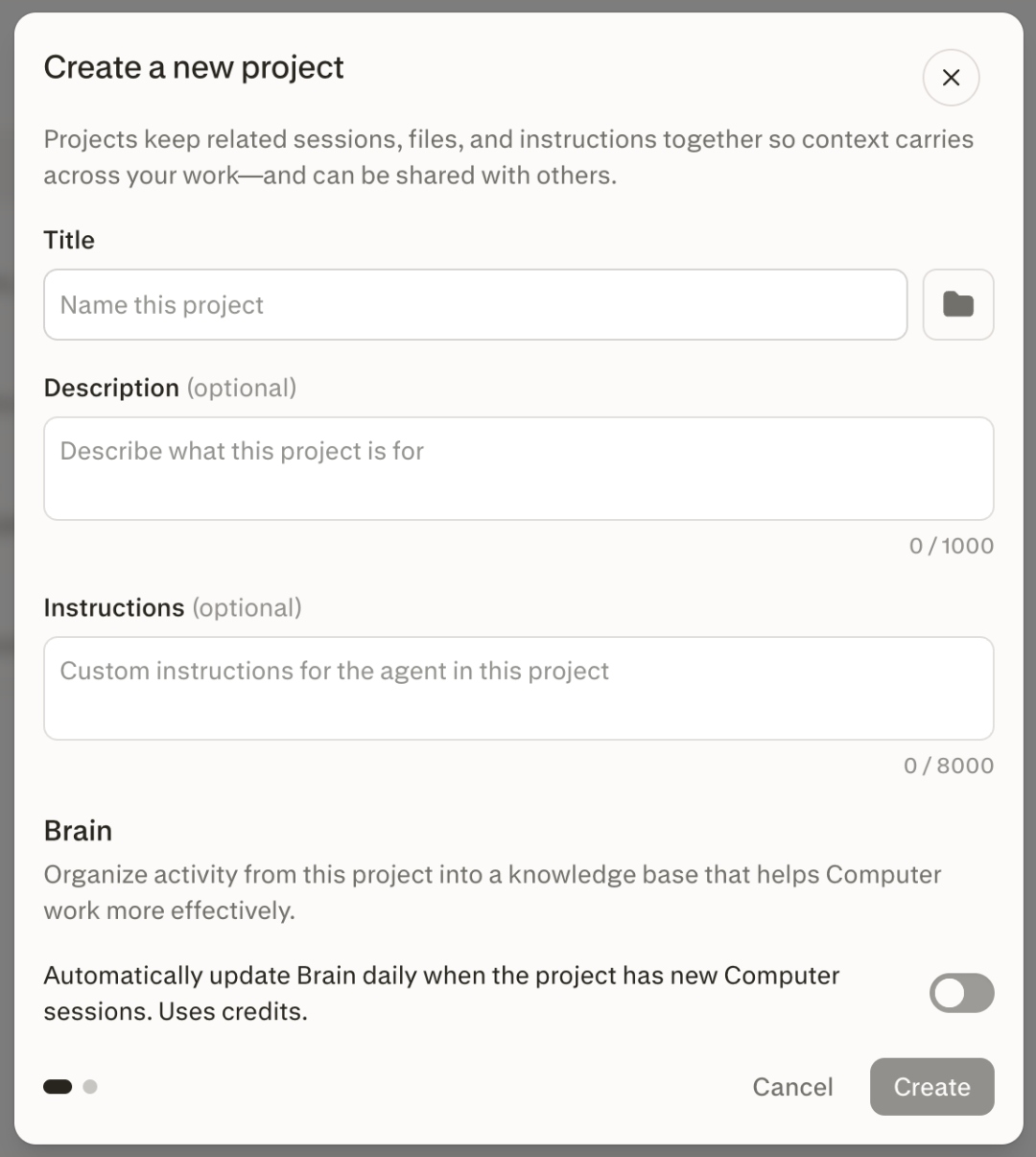
Click the Projects section in the left-side panel to open up your projects menu, then click + New project. You can also click on the + hover option in the Projects header
Give your Project a title (up to 50 characters), an optional description (up to 1,000 characters), and an optional icon/color to make it easy to recognize.
Add instructions (up to 8,000 characters) that tell Computer how to work inside this Project — for example, a preferred response format or a status file to keep updated.
Projects are private (Restricted) by default. You choose who to share with in the next step.
You can also start a Project from an existing session, and Perplexity will suggest a title, description, and instructions based on it.
In a Computer task, use Convert session to project to spin up a Project and carry your files and artifacts into it or just ask Computer to create a project from an ongoing session or from existing sessions.
Collaboration and sharing
Click on the portrait list of project members on the top right of a project, or the Share button to manage access and sharing permissions.
Roles
Owner (full control)
Can edit (edit context, files, connectors, skills, people, defaults, channels)
Can view (read the Project and shared sessions/files).
Access scopes
Restricted (invited people only — the default)
Organization can view
Organization can edit (Enterprise)
Anyone with the link can view (if your org allows public sharing).
Contributor limits: up to 5 contributors on non-Enterprise Projects; up to 9,999 on Enterprise-owned Projects.
Enterprise controls: admins can restrict public sharing, external invites, and org-wide publishing.
Project files
Each Project has access to Files. You can upload persistent files individually, as folders, and as imports from connected file sources to serve context in a project. Computer can also create, update, and manage files on your behalf.
Files in a project are shared with project members with the appropriate permissions. Viewers and editors can view files but only editors can edit project files.
Brain
Brain helps build ongoing memory for all work done in a project. You can view the current memory generated in the Brain tab.
Brain runs are billed to the creator of the project and you can control whether it runs automatically or manually in the memory section in the Settings tab.
Project settings
Additional context can be added and managed in the Settings tab and can be configured by the project owner.
Context
Add and manage instructions that are used for every query run in the project
Add and manage web links and domains to be prioritized
Manage the default mode (Search vs. Computer) and set a default Computer orchestrator model
Memory
Enable and manage project level Brain settings. Brain builds a live and updating knowledge base based on the project’s activity to give Computer better context
Enable and manage project summary settings. Project summary generates a running status update of the work done in a project. If enabled, it will also leverage Brain for more context
Control whether queries in the project are allowed to draw from individual memory
Slack and Teams
Bind Slack or Teams channels to this project, ensuring that context from these channels is included in project context and that any Computer queries submitted in those channels show up in the session history of this project
Connectors
Choose which connectors the project uses and add connector-specific instructions
Add shared project-level credentials
Note: Selecting a connector for a Project shares the source and its instructions with every member — it does not share any one member’s sign-in. For connectors that use your own account sign-in (for example, Microsoft 365, Google Drive, or Notion), each member who wants results from that source must connect their own account. Project-level credentials cover custom API credentials (for example, a bearer token or API key added for Computer), not Microsoft 365 or other OAuth-based connector sign-ins.
Skills
Upload and manage reusable skills scoped to the project. Note that users will still have access to personal and organization skills within a project as well
Organizing your Projects
Pin important Projects for quick access. Pinned projects show up in the project overview page as well as in the Projects section in the left-side bar.