Key output
Computer parsed the full data room index and catalogued 33 documents across seven workstreams, flagging five with issues and surfacing an additional 18 critical items that were completely missing. It highlighted missing transfer pricing documentation, partial uploads of top customer contracts, and open questions around open source usage, key-person dependencies, and state tax nexus exposure. For each gap, Computer tagged the associated workstream and ranked the impact on deal risk, so the team could see where the largest blind spots sat.
Next, it cross-referenced 11 core claims in the CIM — from ARR and logo counts to NDR, margins, and projections — against uploaded financials. Four claims were fully verified, three were only partially supported by unaudited data, two (ARR and customer count) remained unverified, one FY2026 projection was unsupported, and one burn-multiple metric was directly contradicted by the numbers.
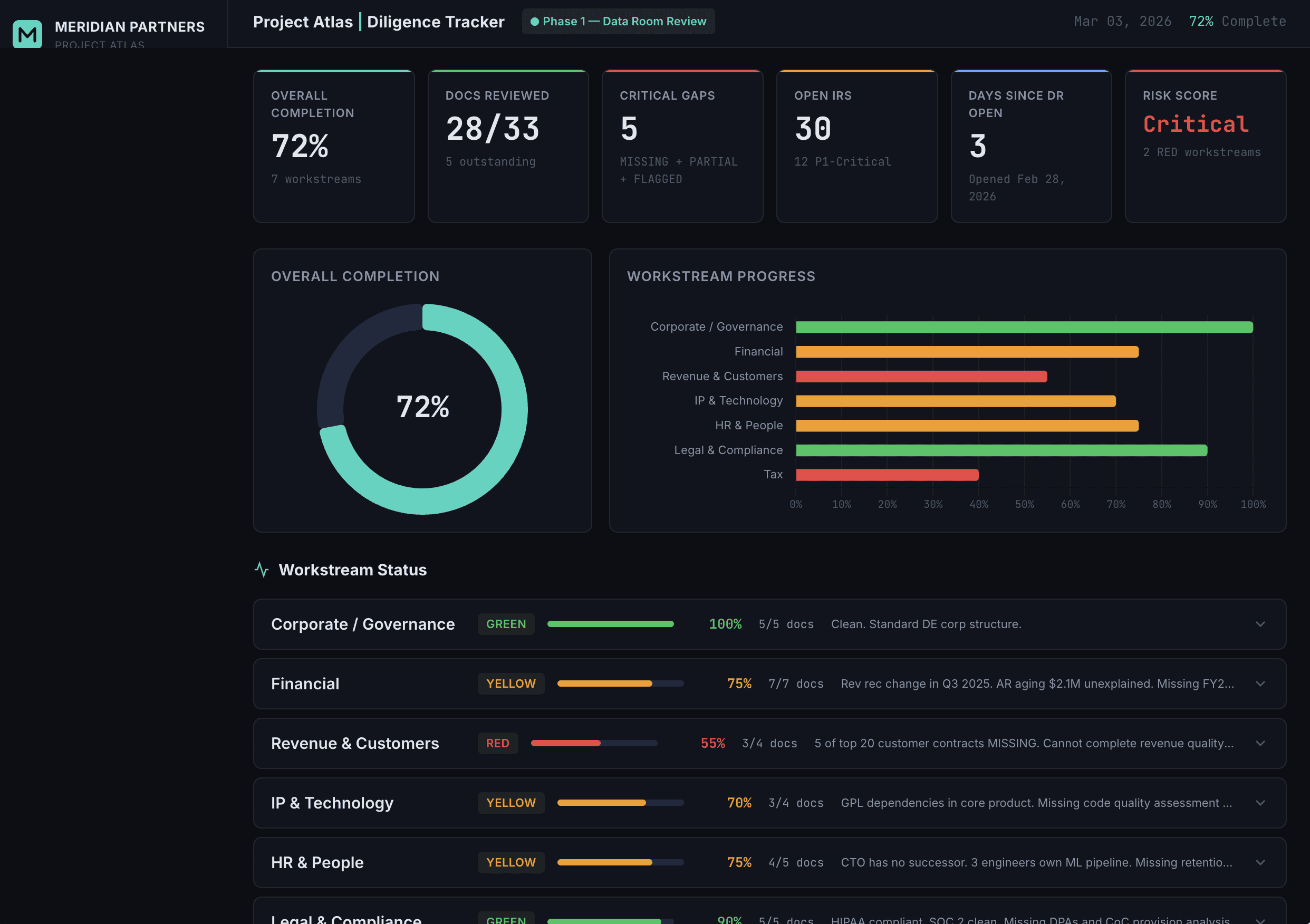
Computer then distilled the findings into a top-10 risk register, estimating potential ARR at risk, tax exposure, IP contamination impact, and valuation sensitivity for each item. It drafted a 30-item, bank-ready information request list organized by workstream and priority, and deployed an interactive diligence tracker website with color-coded status, drill-down on every document and risk, and a live completion meter the deal team could use through signing.
Tips
Anchor deal context up front – Give Computer your mandate and constraints, for example: “We’re a growth equity fund targeting 20–25% IRR and cannot close if tax exposure exceeds $5M.”
Tighten accounting and legal standards – Specify the frameworks that matter, for example: “Flag any deviations from ASC 606, SOC 2, or HIPAA that could affect revenue quality or regulatory risk.”
Define outputs for IC prep – Tell Computer how you’ll use the work, for example: “Structure the risk register and request list so they can plug directly into our IC memo and closing checklist.”