AI integration: Getting ROI from your AI investment
Connecting the right data, tools, and workflows, AI is helping bring businesses real value by accelerating development, improving decisions, and automating repetitive work.
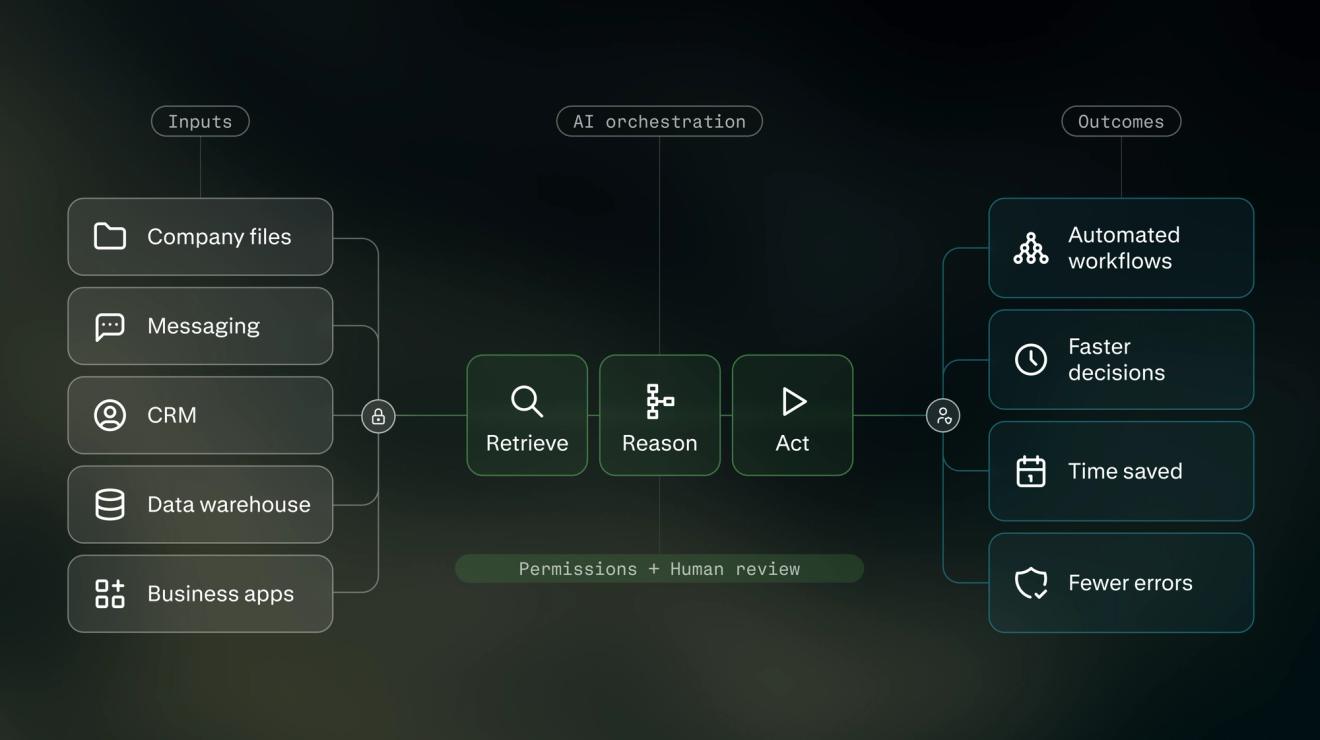
Key takeaways
- Giving employees AI alone doesn’t generate returns. AI needs to be connected to useful data with proper embedding into workflows.
- Businesses need to establish baseline metrics before implementing AI and give employees training with clear goals.
- AI integration analyses information, automates tasks, supports decisions, and takes actions. It works alongside employees to hasten rote tasks so that they can get to the more substantive work. But poor data and disconnected systems will undermine returns.
- AI acceleration depends on governance and human review.
AI integration ROI: what is it and what drives it
Just as the Industrial Revolution accelerated travel through the internal combustion engine, and the digital revolution made communication instantaneous via the internet, the AI revolution is transforming knowledge work, taking on complex data-driven tasks and compressing them down from weeks to minutes.
But what is AI integration? It’s the process of connecting artificial intelligence to an organisation’s existing systems, which includes data, software, and workflows. When AI is integrated into a business’s systems, it can take specific, meaningful actions, pulling data across multiple applications, and helping in core operations. It helps extract the value of the services businesses are already using and paying for, such as converting Confluence project updates into Asana tasks and notifying teams in Slack.
Simply giving employees AI tools doesn’t mean businesses will suddenly see massive returns. Only through proper implementation and governance can businesses see benefits.
Where AI integration has produced measurable ROI
The BOQ Group, an Australian bank, saw the completion of its business risk review go down from three weeks to one day, according to a 2025 Microsoft survey. Additionally, the same Microsoft survey found that the Markerstudy Group’s use of a call summarisation app for its claims department saved its handlers four minutes per call, yielding an annual time savings of 56,000 hours.
Businesses can embed AI capabilities into existing products or workflows, or they can connect their systems to an AI platform that orchestrates work across their APIs and tools. Connecting business systems to an AI platform gives it the organisational context needed to work across internal data sources, applications, and workflows.
Framework for testing AI before wide implementation
What you want to improve | Metrics to consider | Pre-integration check |
Reduce repetitive work | Time per task, output volume | Is AI producing consistent results across tasks? |
Accelerate research and decision | Research time, source accuracy | Quality of output and verifiability of information |
Customer relations | Time per inquiry, satisfaction | What level of complex inquiry can it handle? Is correct customer information being elevated? Is it handing over to a human in requisite situations? |
Error reduction | Error rate, revision time, exception volume | How well did AI flag and fix errors? |
What integrated AI can do
An integrated AI system can help with data analysis, including analysis of unstructured data, along with predictive analysis to help businesses with improved decision making. With AI agents, businesses can automate repetitive tasks, such as putting together weekly market reports. A connected AI assistant can answer routine customer service questions by pulling in relevant account data with humans handling exceptions.
Proper integration can lead to lower operating costs, increased revenue, and reduced vendor or infrastructure spending. For employees, this means time saved. AI can synthesise complex data and produce new conclusions. It can also work across various apps and systems, pulling in multiple data points into one platform. Employees don’t need to copy and paste data between Slack and internal systems while also scrubbing information from PDFs. AI can parse through systems and files, leading to fewer errors and can assist in reaching new conclusions faster.
Seven benefits of AI integration for businesses
- Automates routine work
- Improves data accuracy
- Enables faster decisions
- Scales with growing data
- Accelerates innovation
- Personalises customer experience
- Strengthens competitive advantage
AI isn’t perfect: complexity, data quality, drift, and upkeep
Sometimes AI systems can hallucinate, which is when an AI says something incorrect with confidence. For businesses bringing in AI, it’s important to work with platforms that provide clear sourcing so that workers can double-check outputs. But errors are only one part of the AI integration challenge. Integration complexity, uneven data quality, weak governance, model drift, and maintenance overhead can erode returns. Model drift, in particular, is something that teams should monitor. It’s when an AI workflow performs well during testing but degrades as data and prompts change. It requires continued measurement after rollout. To mitigate the risks, technical leaders should oversee the AI rollout and train employees with a proper permissions structure.
AI adoption doesn’t guarantee ROI
AI should be embedded into existing products and workflows employees already use. Technical leaders can connect systems via an AI orchestration layer. Throughout this process, leaders need to implement proper governance and permissions so that AI is deployed safely.
If AI sits as a separate app, employees will need to transfer data and context manually. In this scenario, AI will lack the organisational context, such as manuals, customer accounts, and other data to produce useful results. And for the IT team, it’ll be difficult to standardise, maintain, and govern.
Where AI integration speeds up work
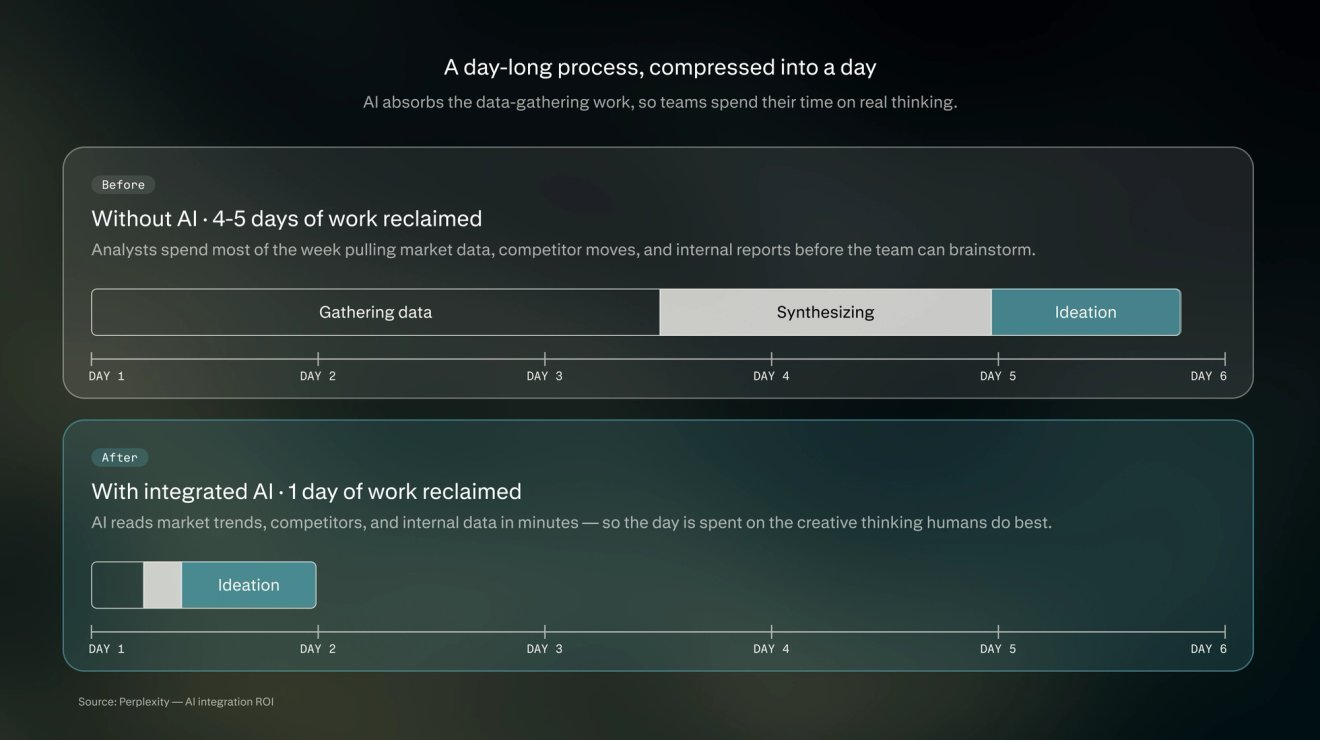
Drafting market analysis reports can be a long, drawn out process. It requires teams to look through changing trends, competitive analysis, and internal financials.
AI might not replace this process, but it can definitely accelerate rote data crunching so teams can spend more time problem solving.
With AI, product development accelerates. It compresses market research, aids in customer discovery, and assists in prototyping and testing. Bessemer Venture Partners, a global venture capital firm, was able to shrink NDA review from 1-2 hours down to minutes, according to a Perplexity customer story.
How AI integration helps with security and fraud detection
Bad actors are using AI to find zero-day exploits, according to a 2026 Google Cloud blog post. As a result, enterprises are raising their own defenses with AI. Cisco recently released an AI platform in June of 2026 that uses defensive AI agents to monitor infrastructure, block intrusions, and remove hackers.
With AI helping security teams, it can run round-the-clock monitoring to identify anomalies, detect fraud, and aid in incident response. AI can also summarise alerts, analyse policies, assist in threat intelligence, and help investigators with reports.
Businesses should establish clear AI guardrails. Big decisions still require human review with clear accountability. It’s up to technical leaders to ensure that security remains up to date as attackers are using more sophisticated AI systems to their advantage.
How AI integration shows up in cost savings
There are some obvious ways in which AI can help businesses reduce costs. This includes using it to analyse legal documents and extract other bits of information. Marketing teams can cut content production costs with AI-assisted content creation.
Teams should always put their own spin on AI inputs so the content feels recognisably human.
Where AI integration can reduce costs
Team | AI-supported work | Where cost savings can appear |
Marketing | Research, campaign analysis, asset adaption | Lower production cost, fewer hours spent on repetitive work and research |
Human resources | Policy research, onboarding, employee-question routing | Lowers administrative costs |
Finance | Reconciliation, invoice processing, expense review, report preparation | Fewer hours, errors, late-payment costs |
Procurement | Vendor research, proposal comparisons | Lowers research costs, shorter sourcing cycles, flags pricing differences |
Legal | Contract review, document comparison, information extraction | Lowers review cost, faster turnaround for routine documents |
Customer relations | Summarise customer data, call routing, solving basic inquiries | Lower cost per ticket, shortens handling time, fewer escalations |
Sales | Account research, CRM updates, lead qualification, follow-up preparation | Lowers research time and cost per opportunity |
IT and security | System monitoring, alert summaries, incident triage, support ticket resolution | Lower cost per incident, fewer hours spent on routine alerts, monitoring protects against attackers |
Why AI integration can fail to deliver returns
. AI has to work inside workflows people already use, not as a separate app beside it. An MIT study found that software developers with access to an AI coding tool increased their coding activity by 12.4% while decreasing project management activity by 24.9%, showing the efficiency AI can bring to organisations.
The adopted platform must also have access to data and systems so that it can reliably act on information. If data is messy, AI can’t properly understand it. There also has to be a built-in feedback loop for human review so that the AI can improve.
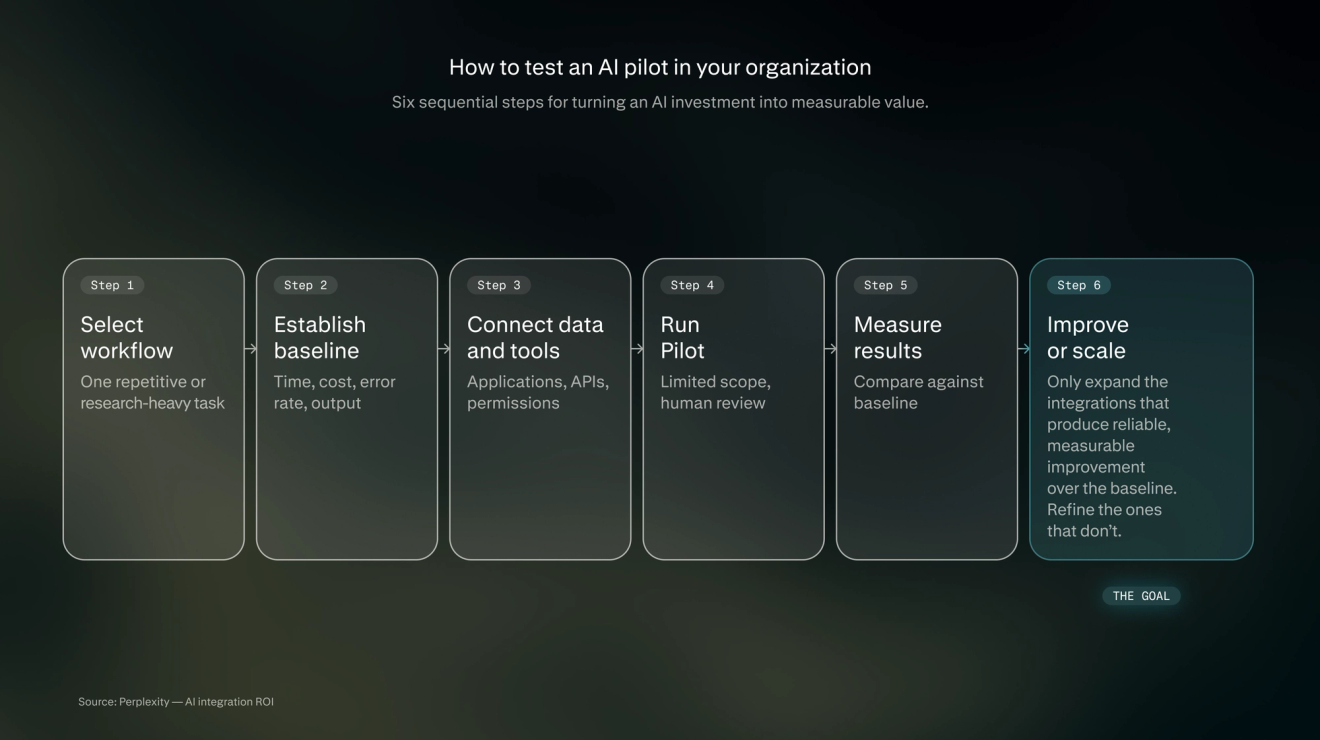
Testing before broad rollout avoids predictable failures. Before rollout, first measure the original process. With that data in-hand, see how quickly processes respond with AI in the mix. Throughout this trial, ensure technical leads give proper permissions for security and oversight.
How to improve the likelihood of positive AI ROI
- Choose one measurable workflow, such as a repetitive or research-heavy process.
- Establish a baseline by recording current costs, completion time, error rate, and output.
- Assess data and system readiness by identifying required applications, APIs, and datasets.
- Set success criteria by defining what improvement justifies continued investment.
- Keep people in the loop with defined reviews and approvals.
- Run a limited pilot and compare results against the baseline.
- Scale only after demonstrating value by expanding integrations that produce reliable improvements.
Using the Perplexity API Platform for business AI integration
Perplexity is an AI platform that helps businesses get accurate answers and automate complex work. It routes tasks across 15+ frontier models including OpenAI, Anthropic, Google, and others, so the best model for the task completes the work..
When it comes to AI integration, businesses can use the Perplexity API Platform to add live, web-grounded search and AI capabilities to their products, internal tools, and automated workflows.
Perplexity Enterprise connects to company files and tools through App Connectors reaching 400+ services, including Slack, Google Drive, and Snowflake. This allows employees to work with internal information along with up-to-date online data to produce outcomes that contain business context. Employees don’t have to move information between systems manually.
The agent platform Perplexity Computer orchestrates agents that let businesses run specific workflows. Rho, a business banking platform, said Computer helped save its product development team 120 hours over a 12-week project and cut meeting times by 90%. Perplexity never trains its models on enterprise customer data.
Conclusion
When properly done, AI integration can save businesses time and money. Teams regain the freedom to pursue more complex tasks with AI accelerating research, document analysis, customer service, and software interoperability.
Team leaders should always test AI systems through focused pilots before expanding access. With effective AI integration and a flexible platform to manage models and connected services, businesses will have the best chance to transform AI investment into lasting value.
FAQs
What is AI integration and can it save my business money?
AI integration is the process by which an organisation connects its systems, such as data, applications, and workflows, to an AI model to accelerate research, product development, and informational synthesis. Only through pilots and training can businesses extract the most value.
What does AI integration look like?
A business can connect AI to a customer support platform to help address product issues, summarise support conversations, and create tickets.
How can businesses measure the ROI of AI integration?
By taking the cost of implementation and subtracting the measurable benefits can businesses learn of AI integration ROI. This means monitoring metrics such as time-per-task completion, error rate per employee, output volume, and customer service agent time.
What does bad AI integration look like?
AI systems are only as powerful as the data and instructions they have access to. Poor data, unclear objectives, excessive permissions, and weak monitoring can undermine results. By performing a limited pilot with a defined workflow and outcomes can businesses ensure proper rollout.
How can businesses use Perplexity to integrate with AI?
The Perplexity platform gives businesses access to App Connectors, allowing for authorised access to company tools and data. The Perplexity AI Platform also allows businesses to connect to AI agents, web search, and other tools for increased productivity.